





6 Reasons To Get More Calcium
 You've read it a hundred times: Get plenty of calcium to ward off bone-thinning osteoporosis later in life. Unfortunately, if you're like most women, you drink milk sporadically (if at all) and take supplements only when you remember to. Which means you probably don't come close to consuming the recommended 1,000 milligrams of calcium per day (1,200 to 1,500 milligrams if you're pregnant or nursing). And a stronger, healthier skeleton isn't all you're missing out on. Research shows that this mighty miner can help ease PMS pains, lower blood pressure, even fight cancer.
Here are six reasons to boost your calcium intake — and some simple suggestions for working more of it into your diet every day.
1. Combat Colon Cancer
Here's a surprise: Although we tend to think of colon cancer as a men's disease, it is actually one of the three most common types of cancer among women. A recent study shows that a diet rich in calcium may help prevent the disease. Without adequate calcium, experts believe, bile and fatty acids — natural byproducts of digestion — can irritate the colon, causing a constant state of cell repair.
"The more cells regenerate, the more they're exposed to toxic agents that can cause them to become cancerous," explains the study's lead researcher, Peter R. Holt, M.D., professor of medicine at Columbia University College of Physicians and Surgeons in New York City. Calcium binds with these insidious acids, preventing them from doing their damage.
2. Prevent PMS
With more calcium in your diet, you may suffer less from the mood swings, headaches, irritability and anxiety associated with PMS. A major study recently showed that a daily dose of 1,200 milligrams of calcium can reduce those annoying periodic signs by as much as 50 percent. "Premenstrual symptoms indicate that a woman has an underlying calcium deficiency," says study researcher Susan Thys-Jacobs, M.D., director of the Metabolic Bone Center at St. Luke's-Roosevelt Hospital in New York City.
Getting ample calcium will also help prevent debilitating bone loss later in life, a particular risk for PMS sufferers.
3. Head Off High Blood Pressure
High blood pressure can lead to heart disease, the leading cause of death for both men and women in the United States. It's also a formidable threat if it develops during pregnancy, a condition called (CQ) preeclampsia.
Calcium from dairy products, however, in combination with a balanced, low-fat diet, may help keep blood pressure in check. In a major government study called DASH ("Dietary Approaches to Stop Hypertension"), calcium was one of a group of nutrients found to lower blood pressure, says Eva Obarzanek, Ph.D., a researcher with the National Heart, Lung and Blood Institute.
In fact, out of the DASH study came the official DASH diet. This eating plan, which is widely dispensed by physicians in the United States to patients with high blood pressure and others, recommends two to three servings of low-fat or nonfat calcium-rich dairy foods a day, such as nonfat milk, nonfat yogurt and low-fat cheese.
4. Avoid Kidney Stones
If you've ever had a kidney stone, you know those minute collections of minerals that form in the kidneys can cause excruciating pain when they pass through the urinary tract and out of the body.
Most kidney stones are made from calcium and oxalate, a salt-like substance found in such foods as beets, spinach, rhubarb and nuts. Your body also makes its own steady oxalate supply. Normally, calcium and oxalate remain dissolved and are excreted in the urine. But stones can form when calcium and oxalate become too concentrated in the urine, forming crystals -- not unlike sugar settling to the bottom of your coffee cup.
A 12-year Harvard University study involving more than 90,000 women, however, found that those with the highest dietary calcium intake had the lowest risk of kidney stones. The theory? Researchers believe that calcium binds with oxalate during digestion and is excreted from the body rather than getting absorbed, preventing stones from forming.
A caveat: The same study also showed that taking calcium supplements without food may actually, in some cases, increase the likelihood that kidney stones will form.
5. Fight Breast Cancer
Ample calcium may also help reduce your risk of breast cancer, especially if you're a milk drinker. A Finnish study involving more than 4,600 women concluded that those who drank roughly three 8-ounce glasses of milk a day had a lower risk of breast cancer than those who didn't drink as much. Researchers suspect that calcium, as well as other components in milk, such as conjugated linoleic acid, may have potent breast-cancer-fighting properties.
6. Curb Weight Gain
Research suggests that a calcium-rich diet -- especially one that includes dairy sources -- not only helps young women keep weight in check but may reduce overall levels of body fat. A small study of 18- to 31-year-old women recently found that those who consumed no more than 1,900 calories but at least 780 milligrams of calcium a day either had no increase in weight or actually dropped pounds over a two-year period. Women with calcium-poor diets, on the other hand, gained weight on the same calorie intake.
Lead researcher Dorothy Teegarden, Ph.D., an assistant professor of food and nutrition at Purdue University in Indiana, suspects that "calcium depresses certain hormones, which consequently improves the body's ability to break down fat in cells and slow fat production."
Young Living's Super Cal
Formulated with calcium, potassium, and magnesium citrate (which is easier for the body to utilize) specifically for proper electrolyte balance, hormonal balance, and muscle and bone development.
Contains: Calcium, Magnesium, Potassium, Boron
Essential oils of: Birch, assists with bone, joint, and muscle pain. Marjoram, supports muscles and nerves. Lemongrass, is used for ligament support. Myrtle, has been researched for its effects in soothing the respitory system.
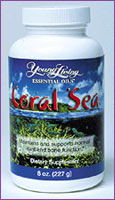
Young Living's Coral Sea
- Calcium is the most abundant mineral in the human body Calcium is needed to form bones and teeth and to maintain good bone health.
- Calcium is also required for bloodclotting, transmission of signals in nerve cells, and for muscle con- traction.
- Coral calcium is a natural calcium supplement containing organic sea coral.
- Coral calcium is naturally infused with 58 trace minerals found in the sea.
- This finely ground coral calcium is the highest-grade product available.
Unique Essentials:
- Coral Sea provides an excellent source of calcium. Regular exercise and a healthy diet with enough calcium helps White and Asian teens, young adults, and women maintain good bone health and may reduce their high risk of osteo- porosis later in life.
- Coral Sea contains a bioavailable form of calcium. It is believed that coral calcium consists of a natural organic chelated source of calcium. Ionic calcium (Ca++) in the sea is incorporated into the living coral structure. A recent human study found coral calcium to be better absorbed than calcium carbonate.
- Coral has been scientifically analyzed to contain over 60 elements. These elements are necessary co-factors for all biochemical reactions in the body. The 1992 Earth Summit Conference reported mineral levels in North American farm and range soils have declined by 85% in the last 100 years.
- Coral Sea contains only ancient coral mined from the land of Okinawa Island. Special care is taken to never hurt the ocean dwelling living coral.
- Once mined, coral calcium sand is pre-pulverized to a finely ground particle size similar to talc (3 micron particle in diameter). The small particle size increases surface area for the calcium to be released. Coral Sea contains the most finely ground coral known on the market today.
- Limited research has found coral calcium preserves cells better than calcium carbonate.
How do I use Coral Sea?
Take one teaspoon mixed in one cup of juice or water, twice daily or as needed between meals.
Who should use Coral Sea?
Coral Sea is a natural calcium supplement. Calcium helps White and Asian teens, young adults, and women maintain good bone health and may reduce their high risk of osteoporosis later in life.